
Website design for consultants
A buyer reads a consultant's site to decide one thing: is this the person to call for our problem. The site has to answer that before they open a second page.
What a consulting website needs.
- 01
The problem, stated in the buyer's words
Buyers search for the situation they are in, not for your method. The first screen names that situation and says what changes once it is solved.
- 02
An engagement you can picture
How work starts, what the client does, what you deliver and how it ends. A buyer who can picture the engagement can budget for it.
- 03
Proof a buyer can forward
A result, a client's sentence or a short case written so that one person in a company can send it to another without explanation.
- 04
Your point of view
The position you take that others in your field do not. It is what separates an expert from a supplier of hours.
- 05
Credentials without a CV
Sectors, roles held and clients you can name, shown as evidence for the claim above rather than as a list of jobs.
- 06
One way to start
A single, low-pressure next step for someone who is not yet sure: an introductory conversation, a diagnostic or a short briefing.
One example, in full.
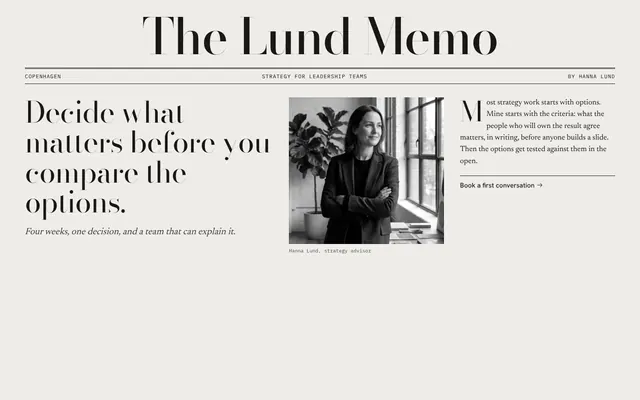
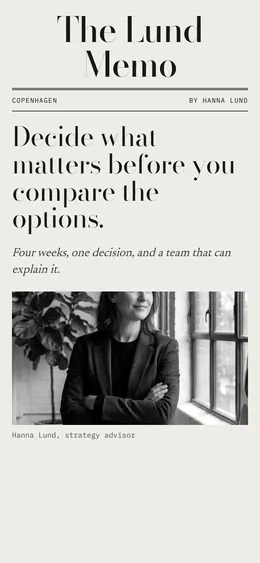
The concept for Hanna Lund is built like a front page, because her work starts with what matters most: the headline is the problem she solves and every section is a story under it.
Concept based on a fictional brief. Website designed and built by us.
More examplesQuestions consultants ask.
Should a consultant publish case studies?
Yes, if clients allow it, and anonymised where they do not. A case written around the situation, the decision and the outcome persuades a buyer more than a list of logos.
I serve several industries. Should the site split by sector?
Only if the buyers differ. Often one clear problem statement works across sectors, with sector pages added where the language and proof change.
Do I need a blog or articles?
Not to launch. A few well-chosen pieces that show how you think help, but a thin blog hurts more than none. We plan what to publish with you.
Can the site support a firm as well as me personally?
Yes. We set out whether the name is you or the practice and design the site so that adding associates later does not mean starting again.
Keep reading.
- Personal brand website designPositioning, identity and website developed as one project for experts who sell what they know, so the right people understand your work and know how to start.
- Speaker website designAn event organiser compares several speakers in minutes. Your site has to show what you talk about, how you sound on stage and how to ask about a date, all on the first visit.
- Website design for coachesA coaching site has one job: help the right client recognise their situation, trust your way of working and book a first conversation without hunting for it.
- ExamplesConcepts for coaches, consultants, speakers and other experts. Each began as one sentence about who the person helps, and each looks like nobody else on the list.
Tell us what you solve.
Describe the problem you are hired for and who hires you. We reply with the scope before anything is agreed.
Request a quoteOpens our quote page.